What an RFID-Blocking Wallet Actually Blocks
The conclusion first
- The pitch writes itself: a stranger brushes past, a scanner reads your card through your pocket, your account empties before you reach the corner.
- The wallets that promise to stop it are lined with metal mesh.
- Both halves of that story need checking.
Drawn from the opening of this entry.
The pitch writes itself: a stranger brushes past, a scanner reads your card through your pocket, your account empties before you reach the corner. The wallets that promise to stop it are lined with metal mesh. Both halves of that story need checking.
The threat model is narrow
Contactless cards and e-passports speak high-frequency RFID at 13.56 MHz under ISO/IEC 14443, the proximity-card standard. Proximity is the point: the standard’s read range is about 10 cm, and real card-reader combinations usually manage around 4 cm. A skimmer needs touch distance — a packed train car, not a walk down the street. Larger readers with bigger antennas can reach further, and they look like luggage, because luggage is roughly what they are.
Meanwhile, the card in the poster is not the card in your pocket. Most cards issued in the US are contact EMV chip-and-PIN with no radio interface at all, and phone payments tokenize, so the real card number never leaves the device even when tapped. The crime itself has stayed theoretical. Roger Grimes, a computer-security writer quoted by NPR in 2017, put it plainly: hundreds of millions of financial crimes happen every year, and so far there had been zero real-life RFID crimes. Thieves who want card numbers buy them in bulk online for cents each. Standing in a camera-covered crowd holding a reader is a bad trade, and the people who commit financial crimes for a living know that arithmetic better than anyone.
How the shielding is built
The lining does one job: form a conductive enclosure around the card. Makers get there in a few ways — woven metal mesh, fabric plated with metal, or a foil laminate sealed between lining layers — and all of them run on the same physics. A reader’s field induces currents in the conductor, and those currents radiate a cancelling field of their own, so the field inside the enclosure collapses to nearly nothing. Faraday worked the principle out in the 1830s; the shielded pouches that hotels use for key fobs run on the identical idea.
The catch is continuity. A cage with a gap is not a cage. Every seam, stitch line and slot opening is a place where the field can leak through, and a wallet is full of them by design. That is why two products carrying the same “RFID blocking” label can test differently, and why the honest ones describe what they shield instead of gesturing at the word.
A per-card sleeve is the geometry that cannot fail halfway: the card sits inside a closed conductive pouch, edges included. A shielded wallet asks more of its construction, because the conductive layer has to reach the folds and slot walls or leak around them. That difference explains why the two categories test differently, and why a brand selling both usually does better with the sleeve.
The shield works — when it fully encloses the card
Consumer Reports tested ten RFID-blocking wallets and sleeves in 2014 with the security firm Recursion Ventures, and none of them blocked every test reader completely; effectiveness also varied between brands. A duct-tape-and-aluminum-foil shield outperformed eight of the ten commercial products. The physics is not in doubt. The geometry is.
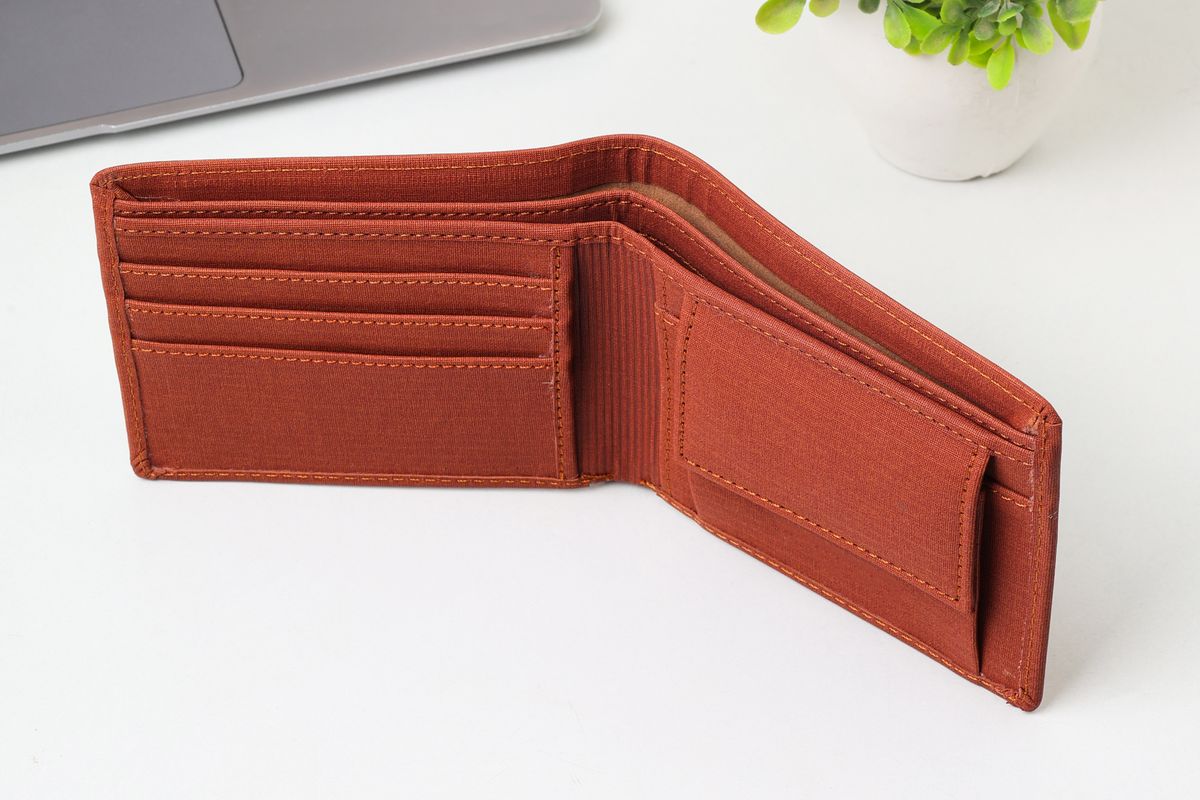
The failure mode is construction. A bifold shields the front and back panels, but the folded edges and the seams around card slots leak signal. A sleeve with the card fully inside and the flap closed is the honest version of the claim; a wallet where one card rides in an outside pocket is not shielded at all — which is why some owners find their transit card stops working inside a “protected” wallet while the card two slots deeper still taps through at the gate. Partial shielding produces exactly the failures nobody wants and blocks exactly the threat nobody faces.
Where the money actually goes
Card fraud overwhelmingly arrives through data breaches and skimmers bolted onto ATMs and fuel pumps, or through plain phishing — none of which a wallet lining touches. And if a fraudulent charge does land, US law caps cardholder liability for unauthorized card use at $50, and most issuers advertise zero liability. The documents genuinely worth shielding are the ones you cannot reissue: an e-passport chip carries your photo, name and passport number, and that data does not change for a decade. A foil passport sleeve covers that one real case for a fraction of what a shielded wallet adds to the bill.
What the feature costs you
Even when it works, the shield has a daily price, paid in behavior rather than dollars. A metal-lined panel stiffens a wallet, so the soft fold that makes a bifold pocketable partly goes away. The enclosure that blocks a skimmer blocks a transit gate and a tap-to-pay terminal with it, which means digging the card out every time. And quick-access slots sit outside the shielded zone by definition, so the cards you actually reach for are the least protected ones you carry. None of this disqualifies the feature. All of it belongs in the decision.
Testing a shield you already own
The gate test deserves a method, because a single pass proves less than it seems. Hold the wallet flat against a transit reader or a payment terminal and wait for the decline; then test the card bare, to confirm the reader was live. Repeat with the card in each pocket you actually use, flipped the other way, and with the wallet fuller than usual, since a stuffed bifold changes the geometry of every panel. A shield that passes with one card but fails when full is telling you the enclosure only works at one thickness. Run the test a few times a year. Shielding laminates can fatigue where a wallet folds, and the failure arrives quietly, as protection you stopped having months earlier.
A fair verdict
Do not pay a premium for shielding on a wallet you otherwise dislike; the risk it addresses is close to zero. Treat the feature as a free add-on when the wallet is right anyway — construction and stitching decide how a wallet wears, and the card layout decides how it works, as wallet constructions compared lays out. If you already carry a “protected” wallet, the method in the section above settles the claim in two minutes, and the same test-first habit from reading a product listing applies to any feature you cannot verify from the page.
FAQ
- Do RFID-blocking wallets actually work?
- The physics works — a conductive enclosure forms a Faraday cage around the card. In practice, Consumer Reports' 2014 test of ten wallets found that none blocked every test reader completely, and a duct-tape-and-aluminum-foil shield outperformed eight of the ten. Panels shield front and back; edges and seams leak.
- Has anyone actually been robbed by RFID skimming?
- No confirmed case is on record. Roger Grimes, a computer-security writer quoted by NPR in 2017, noted that among hundreds of millions of financial crimes a year there had so far been zero real-life RFID crimes — thieves buy stolen card numbers online for cents rather than work a camera-covered crowd.
- Which documents are worth shielding, then?
- The ones you cannot reissue. An e-passport chip carries your photo, name and passport number, and that data does not change for a decade. A payment card can be cancelled in a phone call, and US law caps your liability for unauthorized charges at $50.
Rib count, canopy fabric and the opening mechanism decide whether an umbrella…
Pique and point seams, hand-sewing versus machine work, the four leathers that…
Gram weights, interlining choices, self-tipped ends and the slip stitch on the…
What separates sheet-acetate frames from injected plastic: the Italian supply…